Robert Louis Stevenson wrote The Strange Case of Dr Jekyll and Mr Hyde while living in a house on Bournemouth's West Cliff between 1885 and 1887. The novella, which explores the duality of human nature, was drafted during a period of serious illness that confined the Scottish author to his Westbourne home.
A House Called Skerryvore
Stevenson moved to Bournemouth in 1884, seeking relief from bronchial trouble and the effects of tuberculosis or bronchiectasis. He settled at Skerryvore, a house situated on West Cliff at the head of Alum Chine, the largest chine in Bournemouth. The property took its name from the Skerryvore lighthouse, built off the Isle of Tiree by his uncle, Alan Stevenson. The mild climate and resinous pine-scented air of the south coast drew many invalids during the Victorian era, and Stevenson was among those who came hoping the environment would improve his failing health.
Illness and Unlikely Productivity
Stevenson's time in Westbourne was marked by physical confinement. While at Skerryvore he suffered a haemorrhage that kept him bedridden, yet this period proved one of his most productive. His stepson, Lloyd Osbourne, was attending school locally, and Stevenson was surrounded by his family as he worked. In 1885, the American artist John Singer Sargent visited and painted Stevenson pacing his drawing room at Skerryvore with his wife, Fanny, sitting nearby. The portrait captured an author whose physical frailty stood in contrast to his creative energy.
The Novella Written in Days
The Strange Case of Dr Jekyll and Mr Hyde was written in Bournemouth and subsequently rewritten in as little as three to six days while Stevenson was at Skerryvore. The novella was published in 1886 and became an immediate success. Stevenson also completed Kidnapped at the house during the same period, and worked on portions of Treasure Island while recovering from illness there.
The Lost House and Its Memorials
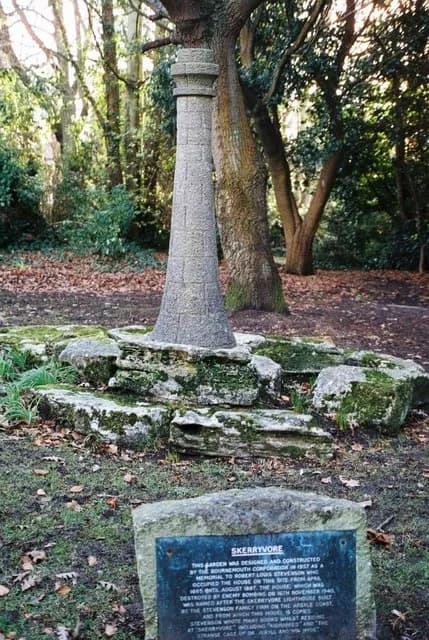
Skerryvore was severely damaged by bombing during the Bournemouth Blitz on the night of 15 to 16 November 1940. Despite a local campaign to save the building, it was demolished after the war. Today, the site is marked by a replica of the Skerryvore lighthouse, built by Bournemouth Corporation in 1957. A small statue also commemorates Stevenson's literary achievements on the spot where the house once stood. Visitors to Westbourne can find these memorials near Alum Chine, a reminder of the author who produced some of his darkest and most enduring work while looking out over the Dorset coast.
What Is Confirmed: Stevenson's residence at Skerryvore from 1885 to 1887; the writing of Jekyll and Hyde and Kidnapped there; the destruction of the house in November 1940; the existence of the lighthouse replica and statue.
What Is Unclear: No direct quotations from Stevenson about Bournemouth itself were located in available sources, and explicit links between local geography and specific scenes in the novella remain unverified.